
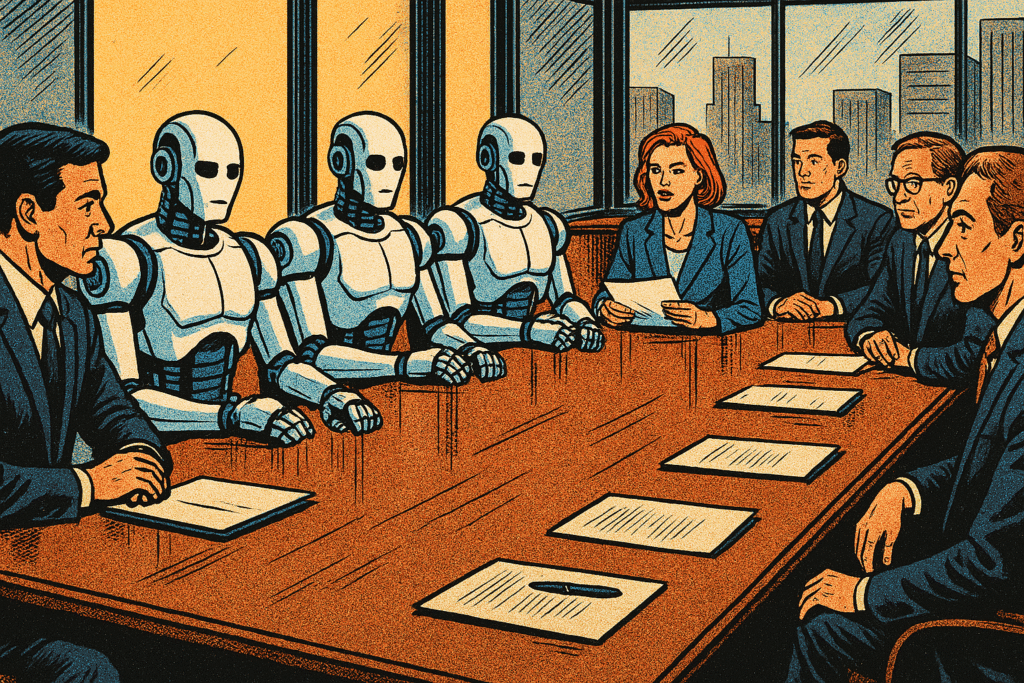
I remember watching a senior analyst at a Fortune 500 firm get “restructured out” after 22 years. His replacement wasn’t another analyst. It was a dashboard. The irony? He had spent two decades mastering a single software suite that the company now automated away in a quarterly budget cycle. He had confused loyalty to a tool with mastery of a skill.
That story is not a cautionary tale about AI. It’s a cautionary tale about positioning.
Here’s the truth that the headlines bury beneath the apocalyptic noise: the future of work isn’t about fewer jobs — it’s about different jobs, reconstructed around what humans do best. And the workers who will command premium salaries, project autonomy, and career resilience in 2026 and beyond are not the ones hiding from AI. They’re the ones strategically absorbing it.
The data backs this up. Three convergent bodies of research — from organizational strategy, labor economics, and information science — all point to the same north star: skill intelligence is the new career capital.
Pillar One: Stop Asking “Will AI Take My Job?” Ask “Which Tasks Within My Job Are Vulnerable?”
The corporate conversation around AI and workforce has been dominated by a fundamentally flawed question. As’ad and Al Omari (2025), writing in AI & Society, cut through the noise with unusual directness: job replacement isn’t just ethically questionable — it’s strategically stupid.
Their argument hinges on a McKinsey finding that most executives conveniently misread. When McKinsey reported that roughly 30% of global work hours could be automated by 2030, boardrooms heard “cut 30% of headcount.” What the report actually said — buried deeper in the analysis — was that fewer than 10% of jobs are fully automatable, while over 60% are partially automatable (As’ad & Al Omari, 2025). The real opportunity isn’t elimination. It’s task transformation.
Think of your job not as a monolith but as a bundle of micro-tasks — some routine and algorithmic, others relational and contextual. AI is extraordinarily good at the former. It is, for the foreseeable future, mediocre at the latter. The organizations winning this race aren’t the ones shrinking headcount; they’re the ones redistributing tasks and elevating their people into higher-value configurations.
For your career, the actionable takeaway is this: audit your own task bundle. Which 40% of your workday is repetitive and rule-based? That’s where you automate. The remaining 60% — judgment, relationship management, creative synthesis, ethical navigation — that’s where you double down. The workers who learn to operate at this human-machine frontier are not replaceable. They’re indispensable.
Pillar Two: The Data Doesn’t Lie — But It Does Have a Time Horizon
If organizational strategy tells you how to reposition, labor economics tells you when. Huo, Ruan, and Cui (2024), analyzing provincial manufacturing data across China from 2011 to 2020, identified a pattern that should reshape how every professional thinks about their career trajectory.
Their central finding: AI’s relationship with total employment follows a positive U-shaped curve. In the short term, substitution dominates — machines displace routine labor, and employment dips. But in the long run, the creation effect takes over — new industries, new roles, and new demand for high-skill talent emerge and push employment back up (Huo et al., 2024).
The implication is not comforting to those who are standing still. Low-skilled workers, empirically, bear the brunt of the substitution phase. The data showed that every 1% increase in AI development triggered measurable reductions in low-skilled manufacturing employment — more severely than for middle- or high-skilled workers (Huo et al., 2024). That polarization is not theoretical. It’s a trend line with your name on it if you’re not moving up the skill curve.
Here’s the lingo bingo that matters: skill-biased technological change — the economic term for AI’s tendency to reward complex, non-routine cognitive work while automating away structured, predictable tasks. We’re not at the bottom of the U yet for many industries. But the inflection point is coming. The workers and organizations who begin upskilling before the curve turns are the ones who ride the creation wave. The rest get washed out by the substitution tide.
Pillar Three: The Bigger Game — Redefining What Makes You Valuable
The deepest insight doesn’t come from economics — it comes from philosophy. Wang and colleagues (2025), presenting at the 88th Annual Meeting of the Association for Information Science and Technology, framed the AI disruption in terms that most career strategists haven’t caught up to yet: this isn’t just a labor market shift. It’s a human value reconstruction.
Historically, work defined identity. Your title, your industry, your employer — these were the coordinates of who you were. AI is dismantling that equation. As Wang et al. (2025) argue, in a world where AI handles repetitive cognitive and physical labor, human value must be reconstructed along three new axes: survival (securing income in a volatile labor market), cognition (rebuilding self-identity independent of job title), and practice (actively fostering and protecting human creativity).
The career danger isn’t just unemployment. It’s an identity crisis that turns high-potential professionals into paralyzed bystanders. The individuals who will command the new economy are those who lead with uniquely human strengths: curiosity-driven problem-solving, cross-domain synthesis, ethical judgment, and — critically — the creativity that AI-generated outputs can simulate but never authentically originate (Wang et al., 2025).
What this means practically: invest in skills that sit at this intersection. Prompt engineering, data literacy, critical analysis of AI outputs, human-centered design, negotiation, emotional intelligence — these are not soft skills anymore. They are hard competitive advantages in a market being reshaped by machines.
Your Move
The U-curve is real. The task transformation is underway. And the window for positioning yourself on the right side of this shift is open right now — but it won’t stay open indefinitely (As’ad & Al Omari, 2025).
The workers who flourish won’t be the ones who feared AI the least. They’ll be the ones who understood it earliest and built skills that machines can augment but never replace.
Stop asking whether AI is coming for your job. Start asking: which skills are in highest demand right now, and how fast can I acquire them?
Visit axonsynergy.com to explore current, data-driven skill-demand intelligence — and find out exactly which capabilities the market is paying a premium for today.
References
As’ad, M., & Al Omari, A. (2025). The great AI mistake: Why job replacement is the wrong strategy. AI & Society, 40, 5583–5584. https://doi.org/10.1007/s00146-025-02301-1
Huo, Q., Ruan, J., & Cui, Y. (2024). “Machine replacement” or “job creation”: How does artificial intelligence impact employment patterns in China’s manufacturing industry? Frontiers in Artificial Intelligence, 7, 1337264. https://doi.org/10.3389/frai.2024.1337264
Wang, F., Zhu, X., Yang, S., Liu, X., & Liu, Y. (2025). Reconstructing human value in the age of AI: From replacement to liberation? In Proceedings of the Association for Information Science and Technology, 88th Annual Meeting (pp. 1291–1295). Association for Information Science and Technology.